
Usually, the root cause comes down to incorrect alignment angles, worn steering and suspension components that allow those angles to shift under load, or a combination of poor damping and wheel imbalance. By learning how to read the wear patterns on your tread, you can avoid paying for repeat wheel alignments and fix the mechanical fault the first time.
Safety First: When to Stop Driving
Before inspecting your tyres or suspension, apply these basic safety rules:
- Never crawl under a vehicle supported only by a hydraulic jack. Always use properly rated safety stands on level, solid ground.
- If your steering feels loose, if you hear a loud clunk over bumps, or if the vehicle aggressively wanders under heavy braking, treat the issue as an urgent safety risk and have the suspension inspected immediately.
- Replace tyres immediately if wire cords are visible, if there is a visible bulge in the sidewall, or if the tread depth is approaching the legal minimum of 1.5mm.
- For comprehensive guidance on roadworthy standards, refer to your local state authority such as VicRoads or the National Heavy Vehicle Regulator for larger setups.
Identifying the Three Main Wear Patterns
You do not need specialized tools to identify how a tyre is wearing. A visual inspection and running your hands over the tread will usually reveal one of three distinct patterns.
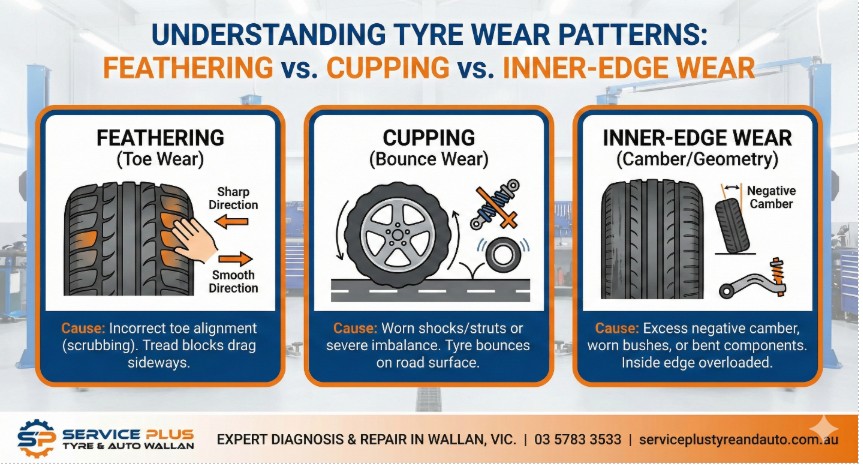
- Feathering (Toe Scrub)
When you run your palm lightly across the tread blocks, feathering feels sharp in one direction and smooth in the other, much like the scales of a fish. This is almost always accompanied by excessive road noise. It happens when the tyre is being dragged sideways slightly as it rolls forward.
- Cupping or Scalloping (Bounce)
Cupping presents as a series of dips, scoops, or scallops around the circumference of the tyre. You will usually notice a distinct roar, rumble, or rhythmic thumping sound that changes pitch as you accelerate. This happens when the tyre is physically bouncing up and down off the road surface.
- Inner-Edge Wear (Camber and Geometry)
This is exactly what it sounds like. The inside shoulder of the tyre wears down completely smooth, or even down to the steel cords, while the centre and outer edges look perfectly fine.
Common Causes and Confirmatory Evidence
Understanding the pattern is the first step. The next step is knowing what mechanical failures cause that pattern, and what evidence a mechanic should look for to confirm it.
| Wear Pattern | Common Mechanical Causes | Evidence to Confirm | Incorrect Diagnoses |
|---|---|---|---|
| Feathering | Toe alignment out of specification. Free play in tie rod ends, rack ends, or worn steering bushes. | Alignment report showing toe out of range. Physical inspection confirming free play in steering joints. | "Bad tyres" or "Needs a wheel balance." |
| Cupping | Weak shock absorbers or struts, worn suspension bushes, severe wheel imbalance, or tyre runout. | Physical inspection of dampers for fluid leaks. Road test confirming bush movement. Wheel balance report showing high weight requirements. | "Needs a wheel alignment." |
| Inner-Edge Wear | Excessive negative camber, incorrect toe settings, sagging coil springs, worn lower control arm bushes, or bent components from pothole impacts. | Will show up in alignment report camber and toe values. Physical inspection confirms movement in control arm bushes under load. | "Normal wear for this model." |
A Practical At-Home Inspection Guide
You can check your tyres safely in your driveway to get a baseline understanding of what is going wrong before you book a service.
Confirm pressure issues first
Tyre pressure mistakes can mimic or worsen mechanical wear. If both the inner and outer shoulders are worn but the centre is thick, the tyre is under-inflated. If the centre is bald but the shoulders are thick, it is over-inflated. Keep in mind that pressure issues often coexist with alignment problems, especially on 4x4s that frequently air down for dirt tracks.
Turn the steering wheel for a better view
Park safely on level ground and turn the steering wheel all the way to full lock. This exposes the entire face of the front tyre. Sight down the tread surface in good light to spot the dips of cupping, or run your hand across it to feel for the sharp edges of feathering.
Check for asymmetry
Take note of where the worst wear is happening. Front-only wear usually ties to steering components and braking loads. If only one tyre is destroyed while the opposite side is fine, it heavily points to a single worn component, an isolated pothole impact, or a bent suspension arm.
The Mechanic's Perspective: Why You Fix Parts Before Aligning
If you have feathering on your front tyres caused by a worn tie rod end, the alignment machine can perfectly centre the wheels. But the moment you drive down the road and apply the brakes, that worn joint allows the wheel to shift backward, throwing the alignment out entirely. This is why a thorough workshop will test for free play in the steering and suspension before they even turn the alignment machine on. If play is found, the worn part must be repaired first.
The same logic applies to cupping. If your shock absorbers are leaking hydraulic fluid and have lost their damping ability, balancing the wheels will not stop the tyre from bouncing. The dampers must be replaced first.

A Note on 4x4 Lift Kits
Even when a wheel alignment is performed after a lift, some vehicles physically cannot be adjusted back into a tyre-friendly window using the factory adjustment bolts. If a lift kit has been fitted and rapid inner-edge wear appears shortly after, it is a geometry problem, not a faulty tyre. Often, these vehicles require aftermarket adjustable upper control arms or castor correction bushes to stop them from destroying front tyres.
A Practical At-Home Inspection Guide
When you take your vehicle in for uneven tyre wear, the goal is a permanent fix. A reliable workshop will document the wear type, repair the worn components, perform a precise wheel alignment, and set the correct tyre pressures for your usual load.
For peace of mind, it is highly recommended to have the tyre wear rechecked after 2,000 to 3,000 kilometres. If you need a thorough tyre wear and wheel alignment check, or a complete steering and suspension inspection, reaching out to a local specialist ensures the job is done right the first time.
This guide is written by a repair shop; use it to compare any provider and ask to see evidence for any recommendation
Frequently Asked Questions
Feathering is most often caused by toe scrub, meaning the wheels are not pointing perfectly straight ahead relative to the vehicle's centreline. Worn steering components can also allow the toe angle to shift while driving, accelerating the wear.
No. While weak or leaking dampers are the most common cause, severe wheel imbalance, tyre runout, and completely worn suspension bushes can also contribute. Cupping is often the result of a combination of these factors.
Inner-edge wear is usually caused by excessive negative camber, toe settings that scrub the inner shoulder, sagging springs, or worn control arm bushes. While some modern vehicles run mild negative camber from the factory, rapid or severe inner wear is a sign of mechanical failure.
It will only fix the issue if the problem is purely an adjustment error and all suspension components are tight. If bushes, ball joints, or steering rack ends are worn out, the new alignment will not hold once the vehicle is moving.
Yes. Under-inflation tends to wear both outer shoulders, while over-inflation wears the centre of the tread. Incorrect pressures can also rapidly accelerate wear caused by minor alignment faults.
You must replace them immediately if the internal wire cords are showing, if there is a structural bulge in the sidewall, or if the tread depth is below the legal limit. Otherwise, diagnose the mechanical fault promptly and monitor the tyre condition.
Yes. Lifting a vehicle changes the factory geometry. If the control arm angles are not corrected properly, it can severely increase tyre scrub. Many lifted 4x4s require aftermarket upper control arms to keep tyres wearing evenly.

