
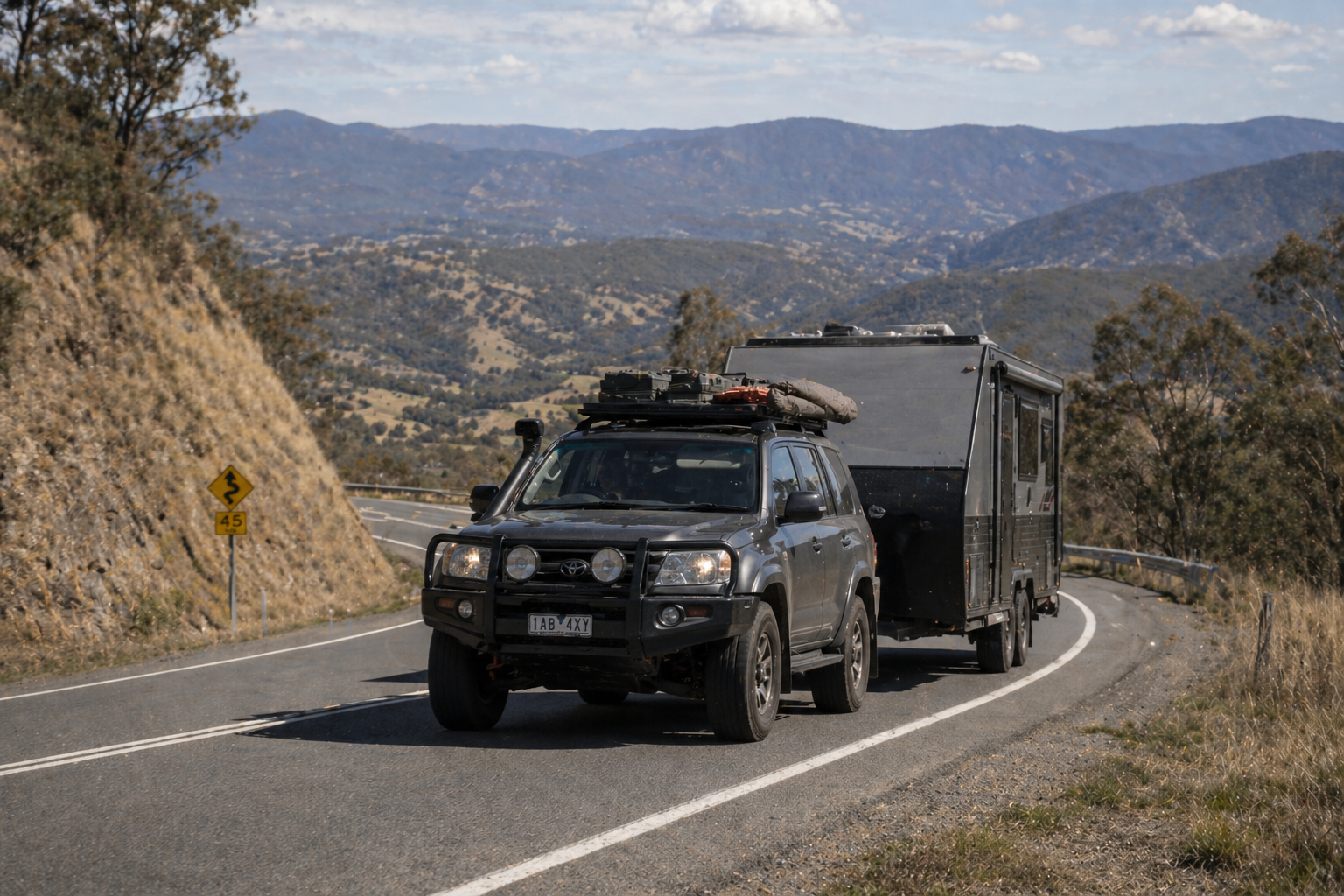
You’re pulling the caravan north out of Wallan onto the Hume, and the bite point is higher than you remember. Or you’re halfway up a climb into the High Country with a loaded 4x4 and the revs rise while the speedo doesn’t. Or you’ve just finished a hill start on a farm track and caught a burning smell through the vents.
Each is your clutch telling you something.
A clutch repair becomes due at different distances depending on how the vehicle is used. Most clutches last 100,000 to 150,000 km in normal use, and heavy use can halve that. If you tow regularly, hill-start a loaded vehicle, run a kitted 4x4, or do a lot of stop-start driving on rural roads, the friction material wears through sooner without anything being ‘wrong’ with the clutch itself.
This article covers the warning signs to watch for, why heavy use shortens clutch life, and what a replacement involves. Service Plus in Wallan handles brake and clutch work across Mitchell Shire and the Hume corridor, so the heavy-use pattern is one we see every week.
What are the warning signs your clutch is wearing out?
Clutch wear shows up as a set of symptoms that get more obvious over time. The earlier you notice them, the cheaper the job stays.
- It slips under load. The engine revs climb but the speed doesn’t follow. It usually shows up first on hills or while towing, because that’s when the clutch has the most torque to transmit. If it slips on flat ground under normal acceleration, the disc is well past due.
- The bite point has crept up. A new clutch engages somewhere in the lower half of pedal travel. As the friction disc wears thinner, the engagement point moves higher. If the bite is now near the top of the pedal, the disc is close to the end of its life.
- Gears crunch or feel hard to get into. First, second, and reverse are the usual suspects. It might be the clutch not disengaging fully, or it might be a worn synchro in the gearbox. Either way, driving through a crunching shift grinds gear teeth and turns a clutch job into a bigger one.
- You catch a burning smell. A sharp, hot smell after a hill start or a tow usually means the clutch was slipping enough to overheat. Once in a while isn’t a disaster. Repeatedly is the end of the clutch.
- The car shudders when it takes off. Shuddering as the clutch engages, especially in first on flat ground, points to a warped pressure plate, contamination on the friction surface (often oil from a leaking rear main seal), or an uneven flywheel. All three are reasons to book an inspection.
- The pedal feels soft, sticky, or inconsistent. A spongy pedal usually means air in the hydraulic line or a failing slave or master cylinder. A sticky pedal often means a tired cable or linkage. Neither is the clutch disc itself, but both stop it working properly.
Why does heavy use speed up clutch wear?
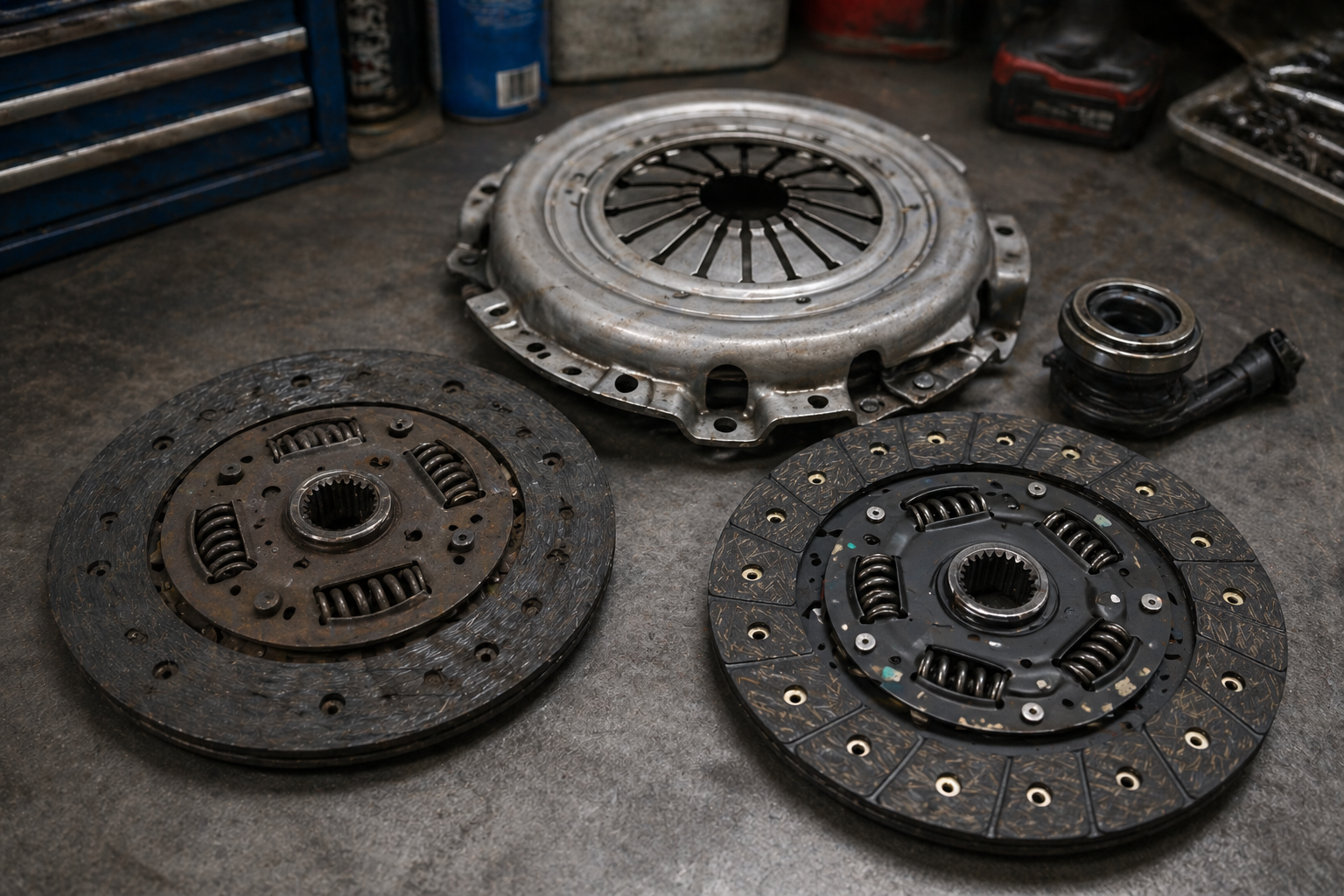
A clutch works by friction. The more friction work it does, the faster the disc wears. Three mechanisms drive that wear, and heavy use pushes all three harder.
- Heat. Every time the clutch slips against the flywheel, it generates heat. The friction disc handles a lot of it, but not forever. Towing up a grade, a loaded hill start, or repeated creeping in traffic puts enough heat into the disc to glaze the surface. A glazed disc slips more, generates more heat, and the cycle accelerates.
- Friction surface loss. The material on the disc is a consumable, like a brake pad. Each engagement removes a tiny amount. Under normal use, the disc lasts over 100,000 km. Under heavy use, engagements per kilometre multiply and the material wears through sooner.
- Pressure plate fatigue. The pressure plate clamps the disc against the flywheel using a large diaphragm spring. Heat cycles and heavy loads eventually take the tension out of that spring. When clamping force drops, the clutch slips even before the disc is worn out.
- Heat, friction surface loss, and pressure plate fatigue apply to every clutch on every vehicle. They bite hardest in these driving patterns:
- Towing. A trailer, caravan, or boat adds tow ball weight to the vehicle and pulling load behind it. Every launch, gear change, and hill start asks the clutch to transmit more torque. The engine behaves the same. The clutch is now moving a heavier vehicle plus whatever’s behind it.
- Hill starts, especially loaded. Starting a loaded 4x4 on a gradient into Kinglake, the Cathedral Range, or further up into the High Country requires the clutch to slip briefly while the engine builds torque. On flat ground, the slip is a half-second. On a steep loaded climb, it’s several seconds, and heat builds fast.
- Stop-start on unsealed roads. Farmwork, gate runs, and long driveway loops on gravel mean constant engagement and release. A thousand kilometres of that puts far more engagements on the clutch than a thousand highway kilometres.
- Loaded 4x4s with kit. A bull bar, steel canopy, drawers, second battery, and full touring load add hundreds of kilos. That weight sits on the clutch at every take-off. The effect is the same as towing, without the trailer.
- Riding the clutch. Resting the foot on the pedal at lights, easing off on a descent, or slipping the clutch to creep at walking pace all cause partial engagement. The disc spins against the flywheel without fully gripping, which is the exact condition that builds heat and wears material. Most people who ride the clutch don’t know they’re doing it.
How long does a clutch last with different driving types?
| Driving type | Typical clutch life |
|---|---|
| Light suburban use, manual sedan | 150,000+ km |
| Mixed use, no towing | 100,000–130,000 km |
| Regular towing (trailer, caravan, boat) | 60,000–90,000 km |
| 4x4 with regular heavy load and off-road use | 50,000–80,000 km |
| Commercial or fleet heavy use | 40,000–60,000 km |
Indicative Australian industry figures. Actual life depends on vehicle, driver habits, and whether the clutch has ever been allowed to overheat.
How can you make your clutch last longer?
Good habits won’t save a clutch that’s already worn through, but they do earn real kilometres when the disc is still healthy.
- Get your foot off the pedal between shifts. If you’re not about to change gear, your foot doesn’t belong on the clutch. At lights, drop into neutral and put your foot on the floor. Resting on the pedal wears the release bearing and partially disengages the disc.
- Start in the right gear. Pulling away loaded or on a gradient, use first, not second. Starting in too high a gear forces the clutch to slip longer to match engine speed to wheel speed, which is exactly when friction material cooks.
- Use the handbrake for hill starts. Slipping the clutch to hold the vehicle on a hill, or rolling back half a metre and catching it on the clutch, is the fastest way to glaze the friction surface. The handbrake does that job without wear.
- Match revs on downshifts. A quick blip of the throttle as you change down brings engine speed up to where the gearbox wants it. Without the blip, the clutch absorbs the mismatch, which wears the disc.
- Don’t launch from a standing start. Revving up and side-stepping the clutch is spectacular to watch and brutal on the parts. A smooth release from just-off-idle is kinder to everything downstream of the pedal.
- Habits help, but they don’t undo wear that has already happened. If the clutch is already slipping, shuddering, or the bite point has climbed, no amount of gentle driving brings the friction material back.
When should you book a clutch repair inspection?
Two or more symptoms showing up together is the threshold for a clutch repair inspection. A higher bite point on its own might just be normal wear at 80,000 km. A higher bite point plus occasional slipping under load is a clutch asking to be looked at before it lets go completely.
An inspection starts with a test drive. A mechanic provokes slip under load, feels for shudder on take-off, checks the pedal for sponginess, and listens for bearing noise. Some vehicles allow a visual check through a bellhousing port, but on most modern cars and 4x4s the gearbox has to come out for a full visual on the friction surface and flywheel.
Driving on a slipping clutch isn’t safe and isn’t cheap. Slip generates heat that scores the flywheel. A clutch that can’t fully disengage grinds gearbox synchros. What starts as a clutch kit job becomes a clutch, flywheel, and possibly gearbox job, and the bill climbs with each.
What’s involved in a clutch replacement?
Clutch replacement is gearbox-out work on almost every vehicle. The gearbox comes off the back of the engine to expose the clutch assembly, which is why it’s a full day’s work in most workshops. Expect to leave the vehicle for the day rather than wait with it.
The job replaces three parts together as a clutch kit:
- The friction disc (the wear item, what most people think of as “the clutch”)
- The pressure plate (the spring-loaded clamp that holds the disc against the flywheel)
- The release bearing (the bearing that pushes the pressure plate open when you press the pedal)
The flywheel is inspected at the same time. It’s the steel disc on the back of the engine that the clutch clamps against, and it takes heat every time the clutch slips. A lightly glazed or scored flywheel can be machined flat and reused. A deeply scored, cracked, or heat-spotted flywheel has to be replaced. Skipping the flywheel check is a false saving, because an uneven flywheel destroys a brand new clutch disc within weeks.
Dual-mass flywheels, common on diesel 4x4s, utes, and modern European vehicles, work differently. A dual-mass flywheel has internal springs and damping and wears in a way that can’t be fixed by machining. It’s either serviceable or it’s renewed as a unit.
Clutch replacement cost in Australia typically runs from $800 to $2,500 on most passenger vehicles and light 4x4s. Small, compact cars sit at the bottom of the range. Larger 4x4s and European vehicles with dual-mass flywheels sit at the top, and the figure pushes higher again if the flywheel needs replacement rather than machining.
This is a general Australian market range. Final cost depends on the vehicle, the clutch kit used, and what else the inspection finds.
Frequently asked questions
Gearbox problems usually show up as a specific gear, a specific speed, or a specific manoeuvre: noise only in third, vibration only at 80 km/h, whining only when turning. Clutch problems show up under load and during engagement. If the symptom appears when you let the pedal out or when the engine is working hard, it’s the clutch. If it appears at a specific speed or in a specific gear regardless of load, it’s the gearbox.
You can, but you’ll be paying for more than just a clutch kit by the time you stop. A slipping clutch generates heat that scores the flywheel. A clutch that can’t fully disengage damages gearbox synchros. A day or two of careful driving to get to a workshop is fine. Weeks of ignoring the symptoms turns a clutch job into a clutch, flywheel, and possibly gearbox job.
The hands-on work on most vehicles is four to six hours, but you’ll leave the vehicle for a full working day. Same-day turnaround is standard unless the inspection turns up extra work like a damaged flywheel or a leaking rear main seal. Dual-mass flywheel 4x4s and some European vehicles can stretch to a day and a half if parts need to come in.
Towing within the vehicle’s rated capacity doesn’t void the clutch warranty. Under the Competition and Consumer Act 2010, parts must be of acceptable quality and fit for the purpose the manufacturer advertises, which includes the tow rating published for the vehicle. Towing above the rated capacity is a different question, because the clutch is being used beyond its design. Keep a record of tow ball weight and trailer mass so you can show you stayed within the published figures if a warranty claim comes up.
Not always. A flywheel with minor scoring or glazing can be machined flat and reused, which adds a modest labour charge and saves you the price of a new flywheel. A cracked, deeply scored, or heat-spotted flywheel has to be replaced. On dual-mass flywheel vehicles, machining isn’t an option, and a new DMF often costs more than the rest of the clutch kit combined. The call is made after the gearbox is out and the flywheel is on the bench. Budget the replacement as a contingency so you’re not stuck waiting on parts if the inspection goes against you.
Back to that pull out of Wallan
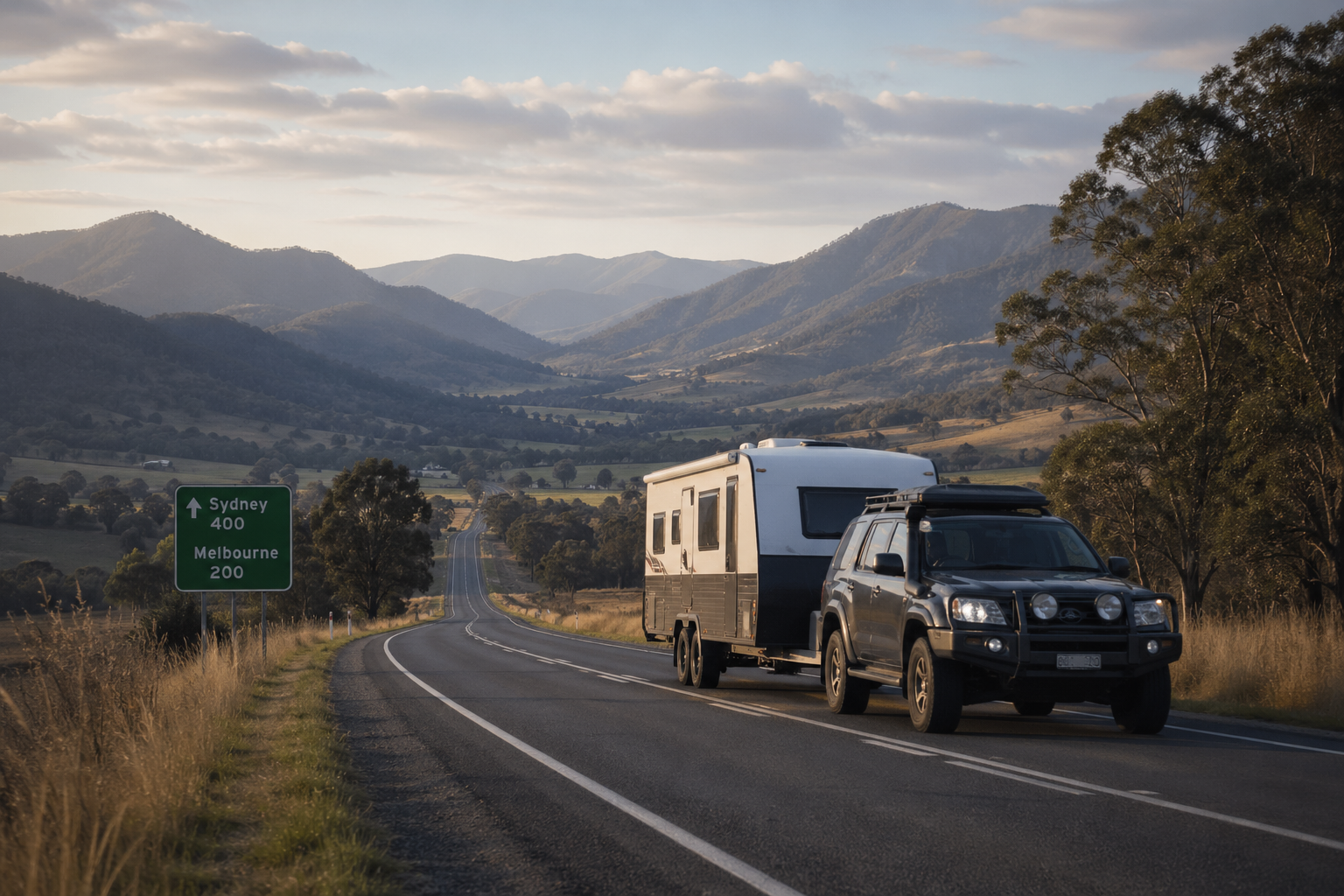
If the bite point has crept up, the engine revs without the speed following, or there’s a burnt smell after a climb with the van behind you, don’t leave it until you’re stopped on the Hume. Two or more of these signs together is the threshold to book in.
Service Plus in Wallan handles brake and clutch work across Mitchell Shire, the Hume corridor, and the rural runs north of Melbourne. An inspection takes an hour or two, tells you whether the clutch has life left or it’s time for a replacement, and gives you a quote before anything is pulled apart. Book in through the contact page or call the workshop.

