
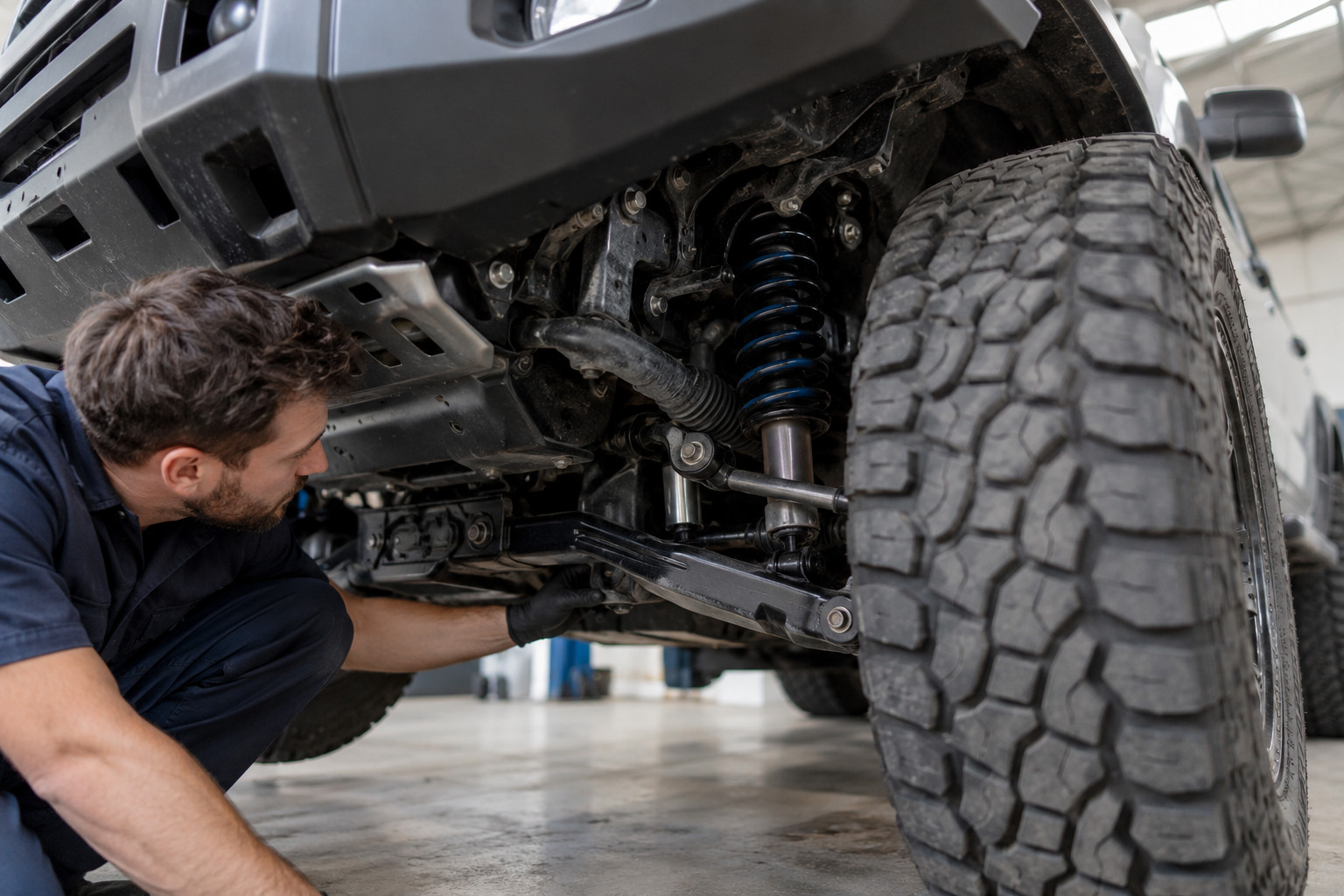
You reverse out of a parking space with the wheel on full lock, and there it is. A steady click, click, click from the front of the ute that was not there before the kit went on.
A lift kit changes more than the ride height. It moves the working angles and the reach of parts built around the standard height. Most of them sit underneath, out of sight. They wear rather than break, so nothing announces itself. Four things are worth checking once the lift is on: the parts whose angles have changed, the tyres and what they are now rated to carry, the geometry once the springs have settled, and what the fitter did about each one.
This one is for people who have already had the lift fitted, not for people deciding whether to. It is not about legality either. That has its own answer in a guide to what is legal in Victoria for lifts and big tyres.
What else moves when the body goes up
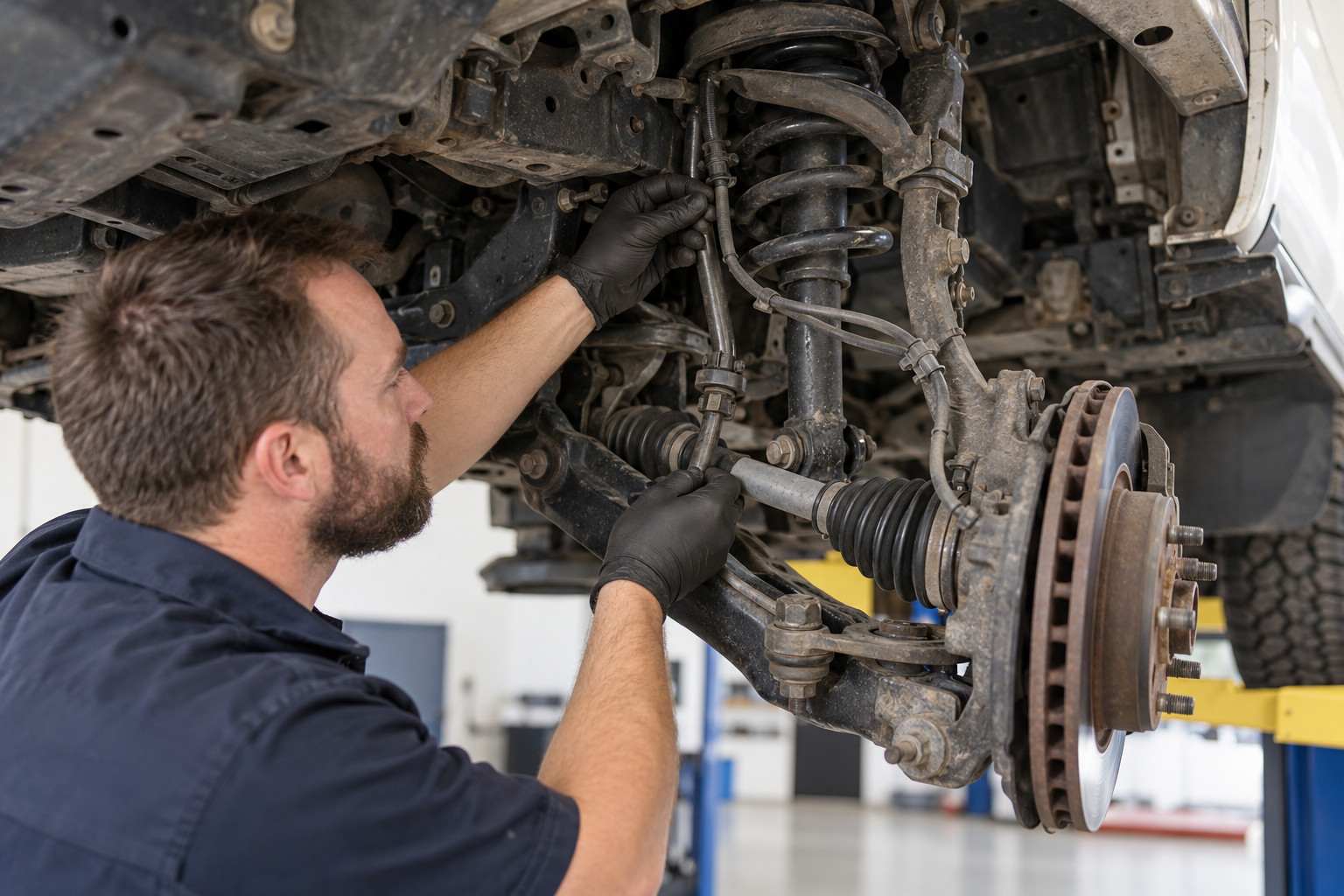
A lift raises the body and chassis away from the wheels. The wheels stay where the road puts them. So every part joining the two now works at a different angle, or reaches further, than it was built for.
None of these parts fails loudly. They wear slowly, and a vehicle that feels good on the drive home can still be halfway into a problem.
- CV joint angles. The constant velocity joints, or CVs, are the couplings at the ends of the front driveshafts. They let the front wheels steer and move up and down while still being driven. After a lift they work at a steeper angle all the time, not only at full lock. The first sign is that click on full lock in a car park, and rubber boots that split early. Where the front wheels move independently rather than on a solid axle, a workshop may look at dropping the front diff slightly. That brings the shafts closer to their old angle. That is a job to assess, not a standard fix for every lift.
- Brake line and ABS wiring reach. Standard brake lines and ABS wiring looms are made for standard travel. After a lift the wheel drops further when the suspension hangs, which fitters call full droop. A line that looks fine on the workshop floor can be pulled tight over a washout or a driveway lip. The check is physical, and it matters most for safety. With the wheel hanging, is there slack in the line and the ABS wire, or is it stretched? Longer lines are made for this reason. Two or three lifted utes a week come through with lines nobody has looked at since the kit went on.
- Bump stop contact. A bump stop is the rubber or foam block that stops the suspension hitting metal on metal under hard compression. A lift changes the gap between that block and what it lands on. Open the gap up and the suspension travels further than it was meant to, so something else runs out of room first. Close it and the stop lands early and hard. The usual sign is a solid knock over speed humps and driveway lips. Most owners decide that is just how a lifted car rides.
- Steering damper. The steering damper is a shock absorber for the steering. It works across a set range of travel, and a lift shifts where in that range it sits. A damper at the end of its travel, or fouling something, rarely makes a noise. It feels like vagueness through the wheel, or a shudder that returns after you correct it.
- Driveshaft and tailshaft angles. The rear tailshaft now runs at a steeper angle to the diff, which loads the universal joints differently. That is the usual reason a vibration turns up after a lift and gets worse the faster you go. On the Hume that is most of the trip. A shake at speed is worth reading properly rather than guessing at. There is a separate article on a car shaking at high speed.
Are the tyres still rated for the vehicle as it now sits?
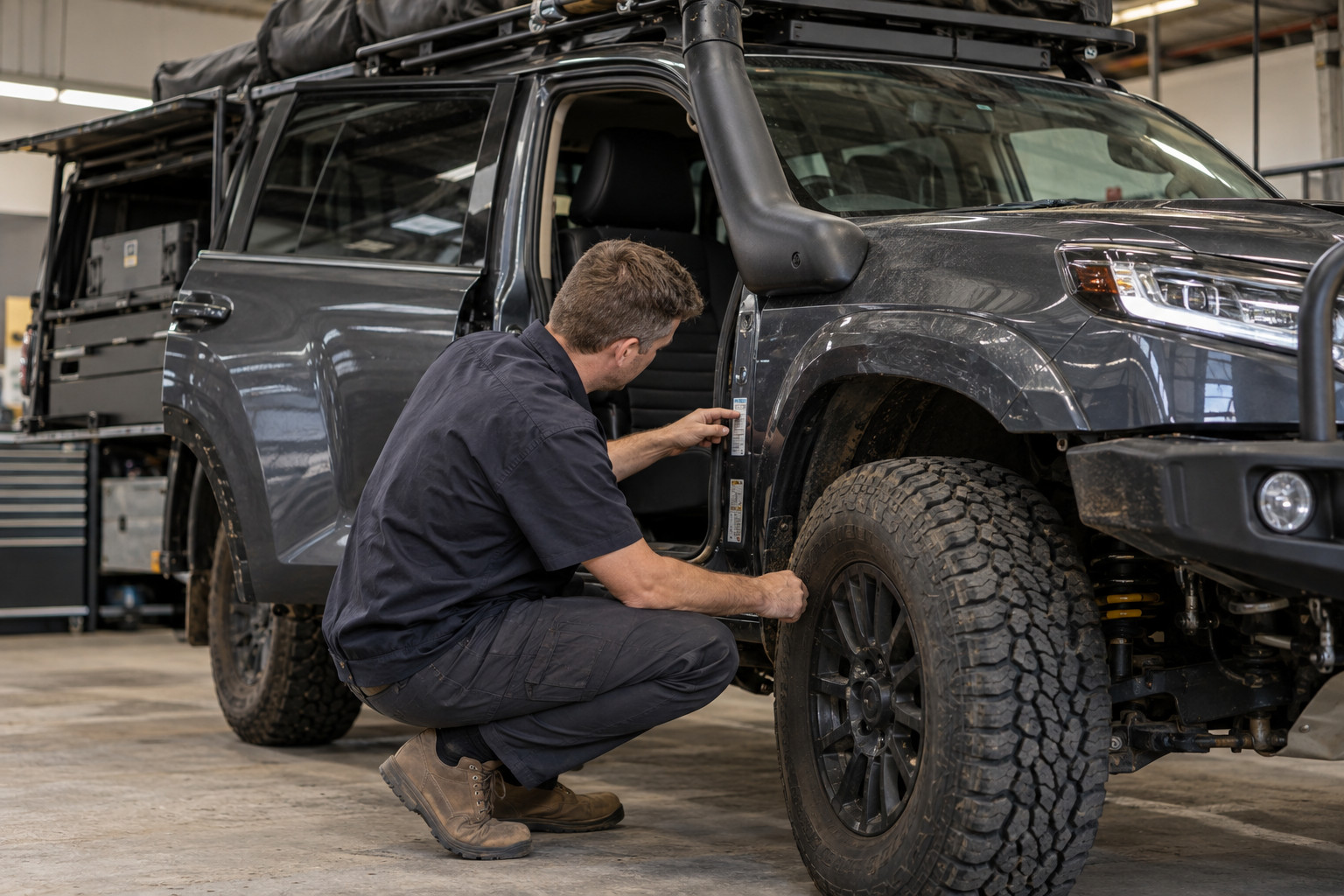
Bigger tyres usually go on with the lift. Two things about them are worth checking again, and neither is about tread pattern.
The first is the load rating, meaning how much weight each tyre is built to carry. It has to be checked against the vehicle’s placard again every time the tyres change. The check only means something against the vehicle loaded the way you use it: the drawers, the second battery, the water, and whatever is on the roof. Not the vehicle empty on the workshop floor. The detail on how to read the numbers on a tyre sidewall is covered separately.
The second is weight, and this is the half that gets missed. Unsprung weight is the mass sitting below the springs: wheels, tyres, hubs, and brakes. A heavier wheel and tyre package is more for the suspension to control over every bump, and more for the brakes to pull up. It also works away at the wheel bearings the whole time the vehicle moves. On the gravel and corrugations north of Wallan that is a constant run of small hits, on bearings chosen for the standard package. The everyday version is simple: the same vehicle, loaded the same way, takes longer to stop. If you tow as well, that is its own set of checks, covered in getting a 4WD ready to tow.
Why one alignment at fitting is not enough
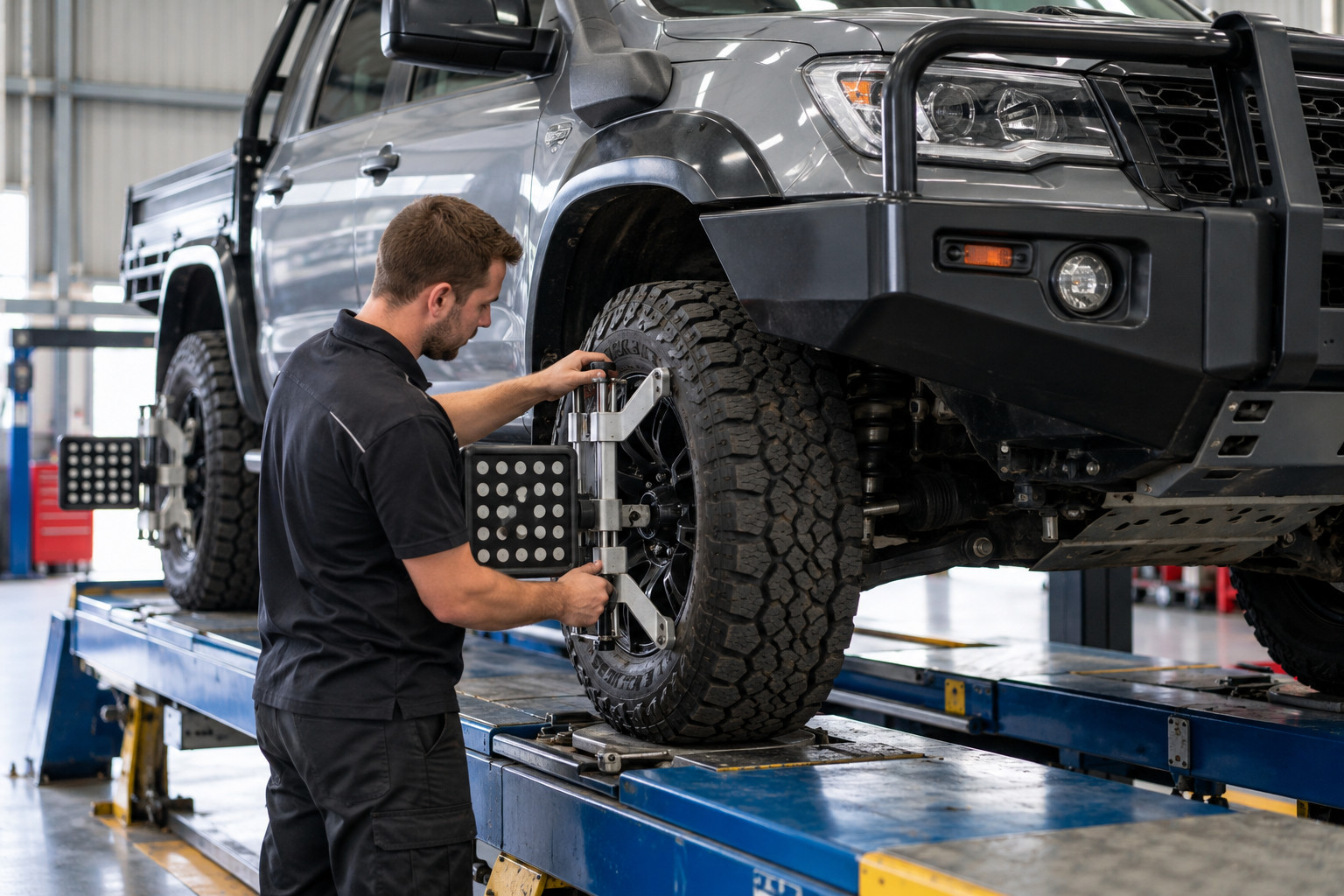
New springs settle. Coils and leaf packs sit down over the first few weeks of normal driving. The height the vehicle left the workshop at is not the height it keeps. The geometry was set on fitting day, at a height the vehicle no longer has. Nothing was done wrong. The vehicle simply moved after it left.
The vehicle that was set up on fitting day and the one sitting in your driveway now are not quite the same shape.
The useful measure is not a date on the calendar. It is the state of the vehicle. Once the springs stop moving, the ride height holds steady. That is the height the vehicle will keep, and the geometry is worth setting to it. The same goes after most suspension upgrades, not only a full lift kit. It is also the moment to look back over the parts in the first section. They have all been working at the settled angles, not the fitting day ones.
If the tyres have started wearing unevenly by then, that pattern is worth reading. There is a guide to tyre wear patterns on this site.
There is no need to make a separate trip of the settle-in check either. It fits alongside any other suspension and steering work the vehicle is due.
What to ask whoever fitted your lift kit
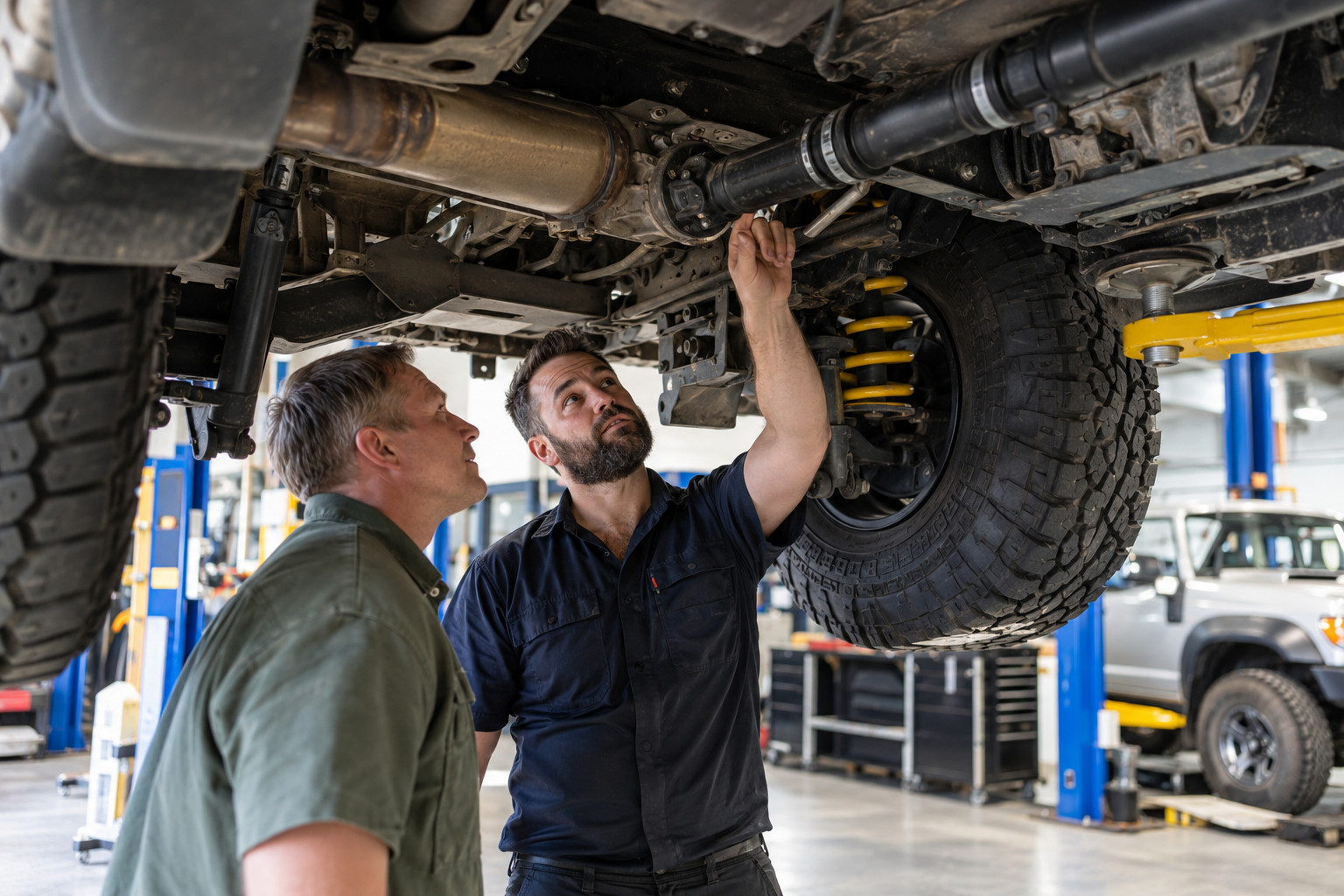
Almost none of this is visible from the driver’s seat, and plenty of readers had the kit fitted somewhere else. These are fair questions rather than an accusation, and a good fitter will have the answers ready.
If those questions get a shrug rather than an answer, it is worth having the vehicle looked at underneath. A post-lift underbody and geometry check works through the items in the first section: lines and wiring at full droop, CV angles and boots, bump stops, the steering damper, and the tailshaft angle. It is the sort of thing a 4×4 service should pick up.
- Were the brake lines and the ABS wiring checked with the suspension hanging at full droop, and were longer lines fitted?
- What was done about the CV angles, and was dropping the front diff considered for this vehicle?
- Were the bump stops adjusted, extended, or left as they were?
- Is the tailshaft angle inside what the universal joints will live with at highway speed?
- When should the vehicle come back for its second alignment, once the springs have settled?
The lift, the tyres, and the alignment all happen in the one building at Service Plus in Wallan. So the check and anything it turns up do not become three appointments. You can book the settle-in alignment at the same time, during the week, and ask for the work to be quoted first.
If the kit is not on yet, the detail sits on the 4×4 lift kit installation page.
Frequently asked questions
Do you need longer brake lines after a lift kit?
Not always. It comes down to how far the wheel drops when the suspension hangs. It also depends on the spare length the standard line had. Look at the line in that position rather than assuming it either way.
Why does my 4WD click on full lock after a lift kit?
A click on full lock after a lift points at the front CV joints. They turn at a steeper angle now, and full lock asks the most of them, so that is where the noise shows up first. Have it looked at early, because the rubber boots around those joints give out soonest.
How long after a lift kit should you get a second alignment?
There is no set number of weeks, because it depends on the springs and on how hard the vehicle is worked. What you are waiting for is the ride height to stop moving. Once it holds steady, the vehicle is at its real height and the geometry can be set to it.

